
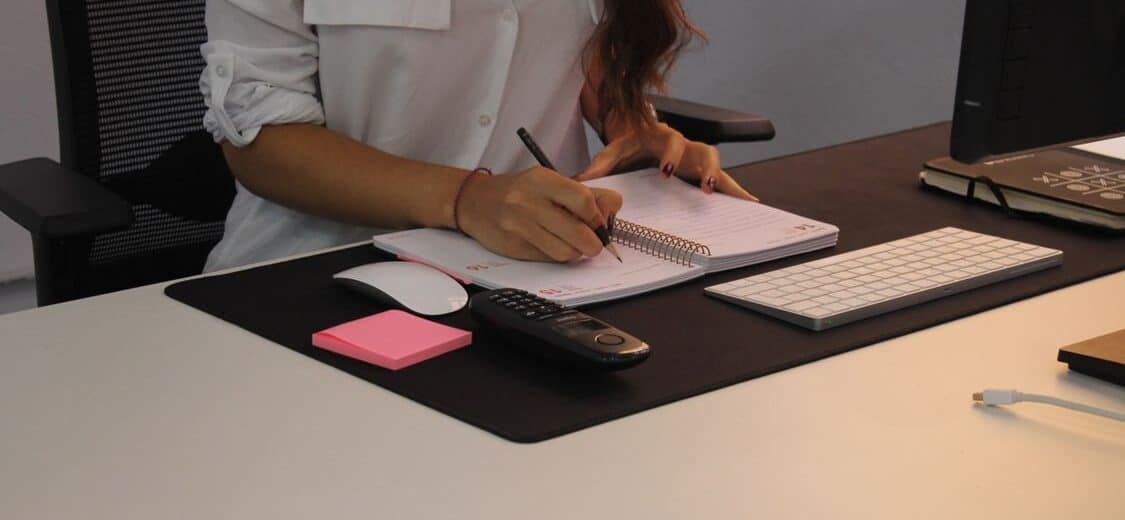

Every office worker has the drawer. It holds the stress ball from a conference, the branded pen that stopped writing, the foam koozie nobody asked for, and a tangle of lanyards from events long forgotten. It is where corporate swag goes to be politely ignored.
Companies spend enormous sums filling those drawers, and a growing number of them have started to notice. The branded giveaway that gets used once and discarded is not building goodwill. It is buying landfill with a logo on it.
That realization is reshaping what companies hand out. One roundup of 2026 swag trends explicitly lists desk mats for polished workspaces among the items worth budget, and the reasoning behind that pick says a lot about where corporate gifting is heading.
The Swag Calculation Has Changed
For decades the logic of branded merchandise was about volume. Order ten thousand of the cheapest imprintable item, scatter them at events, and count the impressions. Quantity was the whole strategy, and quality barely entered the conversation.
That model is falling out of favor for two reasons. The first is sustainability. Employees, especially younger ones, increasingly judge a company by whether its giveaways are thoughtful or wasteful, and a cheap plastic trinket destined for the bin reads as exactly the wrong signal.
The second is simple effectiveness. A giveaway only works as advertising if someone actually keeps and uses it, and most cheap swag fails that test within a week. Spending more on fewer items that survive turns out to be the better investment, not the more expensive one.
The shift, in short, is from many disposable items to a few durable ones. Companies are asking a sharper question before they order anything: will the recipient still be using this in a year, or is this just expensive litter?
Why the Desk Mat Passes the Test

Held against that question, the desk mat performs unusually well. It lands in exactly the environment where the recipient spends most of their working day, and it stays there permanently rather than being used once and forgotten.
A hybrid worker who receives a branded surface puts it on their desk and sees it every time they sit down. That is daily, sustained exposure of the kind no pen or tote bag can match, because the item is not occasional. It is part of the furniture.
It is also a large, uninterrupted canvas. Most swag offers a tiny imprint area squeezed onto a curved or cluttered object. A desk surface gives a logo room to sit cleanly and look considered rather than crammed, which makes the branding feel like design instead of an afterthought.
Then there is the keep factor. People throw out clutter, but they do not throw out the functional foundation of their workspace. A surface that protects the desk and feels good under the hands earns its spot, and an item that earns its spot is an item that keeps advertising for free.
The clearest place all of this pays off is onboarding. A new hire’s first day sets the tone for how valued they feel, and the welcome kit is the physical expression of that. A box of forgettable trinkets says one thing; a set of genuinely useful gear says another.
For remote and hybrid hires, that matters even more. The company cannot decorate a home desk, but it can send something that makes that home desk feel connected to the team, and a surface unifying the workspace under a shared identity does that quietly every day.
It also photographs well in the desk-setup posts employees increasingly share, which turns a single gift into organic reach the company never paid for. A trinket in a drawer generates nothing. A surface on a visible desk generates impressions for as long as it lasts.
What Smart Swag Programs Are Learning
The broader lesson companies are absorbing is that the cost of swag is not the unit price. It is the unit price divided by how long the item actually gets used, and on that math the cheap stuff is the expensive stuff.
A surface that sits on a desk for years has a cost-per-day that approaches nothing, while a giveaway discarded in a week has an effectively infinite one no matter how little it cost to print. The durable item wins the comparison that actually matters.
Personalization sharpens that further. Surveys consistently show people keep items that feel made for them rather than mass-produced, and a surface from a maker like Glide Mousepads, tailored to a team or a moment, lands as a real gift instead of a handout.
None of this means apparel and mugs disappear from the swag catalog. It means the center of gravity is moving toward items that survive contact with real life, and the desk mat has quietly become one of the clearest examples. It is useful, it is permanent, it is a generous canvas, and it never ends up in the drawer. For a company trying to make its branding stick rather than scatter, that combination is hard to beat.